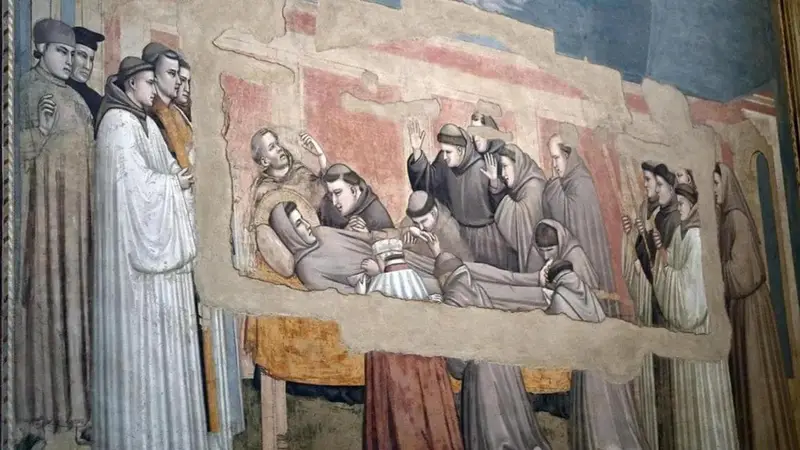
Giotto’s Secrets Revealed: Restoration Unveils Masterful Techniques in Florence Chapel
Firenze – After seven centuries of weathering, the frescoes adorning the Bardi Chapel within Santa Croce Basilica in Florence have been spectacularly restored, offering unprecedented insights into the revolutionary techniques employed by the Renaissance master, Giotto. The four-year project, completed to coincide with the 800th anniversary of St. Francis’s death, has not only cleaned and conserved the iconic artwork but also illuminated Giotto's sophisticated approach to space construction and his innovative use of painting methods.
The restoration, costing €1 million and spearheaded by the Opificio delle Pietre Dure in collaboration with the Opera di Santa Croce, Italian Ministry of Culture, Fondazione CR Firenze, and ARPAI, focused on six scenes depicting St. Francis’s life based on Bonaventure’s Legenda Maior. Superintendent Emanuela Daffra explained that this was ‘a necessary restoration, and by no means a straightforward one,’ highlighting the significant challenges posed by decades of neglect and environmental damage. The chapel's frescoes have faced a turbulent history, including whitewashing in the 18th century and the devastating 1966 flood of the Arno River.
A key revelation is Giotto’s masterful use of ‘secco’ techniques – applying paint to dry plaster – alongside traditional fresco painting. This allowed him to achieve richer color effects, but also increased vulnerability to deterioration. The meticulous documentation of his working methods, revealed through freehand drawings, incisions, and digitally mapped preparatory marks, showcases a remarkably modern approach to architectural illusionism. The restoration team painstakingly treated approximately 5,000 individual areas of missing paint, employing diverse techniques to maximize visibility while respecting the artwork’s historical integrity. Notably, cleaning using laser technology recovered almost-lost details in the depictions of Franciscan virtues – Obedience and Chastity – within the chapel's vault.
Furthermore, the project confirmed Giotto was not working alone; he directed a team of assistants, making the Bardi Chapel a hub for artistic experimentation. The varying hands visible in the frescoes underscore the innovative spirit of the period. ‘Every restoration also opens a window onto the future,’ observed Daffra, emphasizing the ongoing need for conservation and research to safeguard these invaluable cultural treasures.